SEND
Special Educational Needs and Disability Coordinator

Mrs Danielle Chalmers
SEND Coordinator
senco@stwerburghs.wirral.sch.uk
What kinds of SEND are provided for at St Werburgh’s?
St Werburgh’s Catholic Primary School is a welcoming and inclusive mainstream school that provides education for all children aged 2–11. Rooted in our Gospel values and Mission Statement, we believe every child is a unique and precious individual, created in the image of God, and we are committed to ensuring that each pupil can flourish academically, socially, emotionally and spiritually.
We aim to identify and address any special educational needs at the earliest opportunity, working in partnership with parents, carers and specialist professionals. A child is identified as having Special Educational Needs (SEND) if, despite high-quality, adaptive teaching and targeted classroom support, they require additional or specialist provision that is different from or additional to that normally available to pupils of the same age.
At St Werburgh’s, we provide support for children with needs in all four broad areas identified in the SEND Code of Practice (2015):
Communication and Interaction – including speech, language and communication difficulties, and conditions such as autism spectrum disorder (ASD).
Examples of support: Talk About Town (SALT) interventions, TAT SALT programmes, WellComm language development, Makaton, LEGO Therapy, and small-group communication games.Cognition and Learning – including specific learning difficulties such as dyslexia, dyscalculia and barriers to learning.
Examples of support: Quality First Teaching with targeted adaptation, Orrets Meadow Outreach bespoke literacy and dyslexia programmes, Little Wandle phonics support, and personalised English and Maths interventions.Social, Emotional and Mental Health (SEMH) – including attention and attachment needs, anxiety, and emotional regulation difficulties.
Examples of support: ELSA (Emotional Literacy Support) sessions, counselling from Brighter Horizons, social skills and turn-taking games, relaxation and breathing strategies, access to calm areas.Sensory and/or Physical Needs – including visual or hearing impairment, sensory processing needs, and medical or physical difficulties.
Examples of support: Access to sensory tools, use of fidget tools and movement breaks, fine and gross motor development sessions, and liaison with occupational therapists and other health professionals.
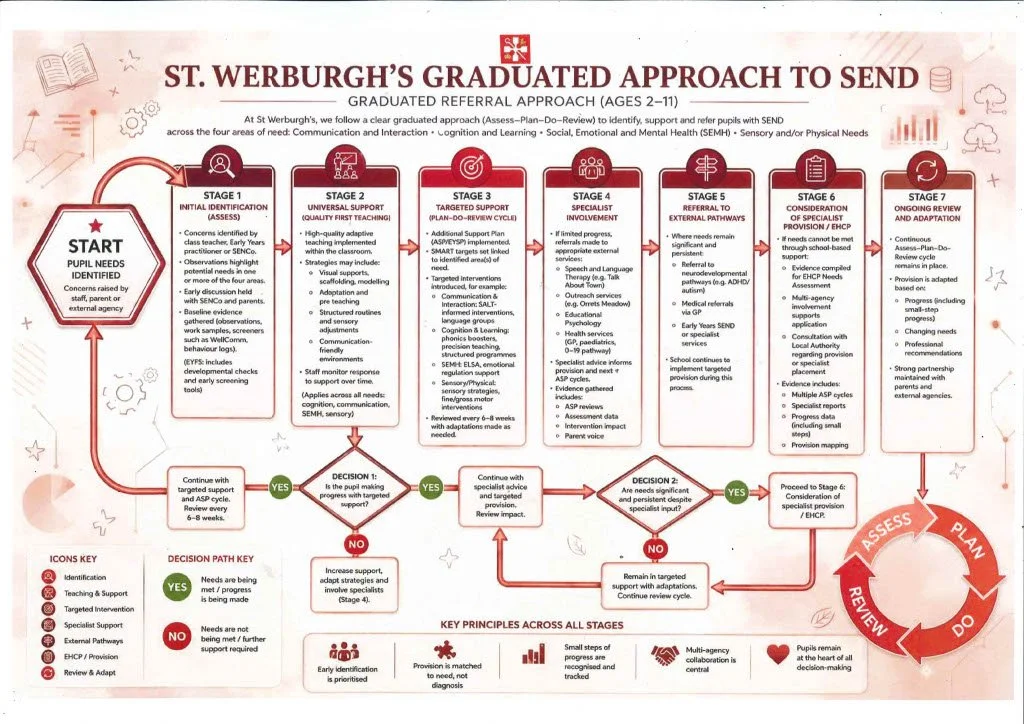
Our provision is delivered through a graduated approach, ensuring that every child receives the right level of support at the right time. This includes:
Universal Offer (Tier 1): Quality First Teaching that is inclusive, adaptive and accessible for all.
Targeted Support (Tier 2): Small group or short-term interventions such as WellComm, Little Wandle, or handwriting and social communication groups.
Specialist Support (Tier 3): Bespoke programmes and 1:1 interventions delivered by school staff and external specialists (e.g. Orrets Meadow Outreach, Talk About Town, Brighter Horizons, and ELSA).
High Needs / EHCP (Tier 4): Statutory provision and multi-agency collaboration for pupils with Education, Health and Care Plans.
How do we identify children with SEND and assess their needs?
We employ a proactive, responsive and inclusive approach to identification and assessment, aligned with the latest inspection focus on early identification, inclusive practice and evidence of impact.
We do this through:
· Transition and early engagement: close collaboration with parents and pre-school settings to understand children’s needs before they arrive.
· Ongoing monitoring and data analysis: frequent, formative assessments of attainment, progress, behaviour and well-being.
· Professional dialogue and staff observations: staff flag concerns early; we use checklists, class reviews and screening tools.
· External specialist input: liaison with Talk About Town, Orrets Meadow, Educational Psychologists, Brighter Horizons, and other professionals.
· Regular review using the “Assess, Plan, Do, Review” cycle: we create Additional Support Plans (ASP’s), review progress with pupils and families, and adapt provision accordingly.
· Co-production with families: parents/carers and pupils are actively involved in planning, target-setting and evaluating support.
We ensure that identification is timely, responsive and based on a balanced judgement of both strengths and needs, rather than waiting for failing performance. We work closely with parents, ensuring that their insights and aspirations for their child are central to all planning and decision-making. Together, we strive to remove barriers to learning, nurture confidence and resilience, and help every child reach their God-given potential.
How do we support children with SEND at St Werburgh’s?
At St Werburgh’s Catholic Primary School, we believe that every child is entitled to an education that enables them to develop their God-given potential, make excellent progress, and experience success in all areas of school life.
We provide a graduated approach to SEND support, ensuring that provision is inclusive, responsive and personalised. Support is structured around four tiers to meet a wide range of needs.
Tier 1 – Universal Offer (Quality First Teaching)
All pupils benefit from high-quality, inclusive teaching that is ambitious, adaptive and well-sequenced, in line with the Ofsted focus on the Quality of Education.
Teachers plan carefully to remove barriers to learning, using ongoing assessment to tailor activities and resources.
Examples include:
· Adaptive teaching, scaffolding and differentiation
· Visual supports, word banks, manipulatives and practical resources
· Calm area and sensory tools within classrooms
· Regular movement breaks and “brain breaks”
· Wellbeing initiatives and a strong Catholic ethos of respect and belonging
· Vocabulary-rich curriculum and explicit teaching of communication skills
· Inclusive classroom environments where diversity is celebrated
Tier 2 – Targeted Support
Some pupils may require additional, time-limited interventions to help close gaps or develop key skills.
These interventions are carefully monitored and evidence-based, ensuring measurable impact.
Examples include:
· WellComm language intervention (Big Book of Ideas)
· Little Wandle Foundations for Phonics
· White Rose Maths small-group sessions
· Fine and gross motor skill development groups
· Social communication and turn-taking games
· Emotional regulation activities and “bubble time”
· ELSA small groups focusing on self-esteem and friendship skills
· Rhyme Time and What’s in the Box? sessions
These targeted interventions complement high-quality classroom teaching and are reviewed regularly using the Assess, Plan, Do, Review cycle.
Tier 3 – Specialist Support
When children require more personalised or sustained support, we work closely with external professionals to deliver specialist intervention tailored to the individual child’s needs.
This ensures our curriculum remains ambitious yet accessible, and progress is closely monitored.
Examples include:
· Talk About Town (SALT) interventions for speech, language and communication
· Orrets Meadow Outreach – bespoke English and dyslexia programmes
· Brighter Horizons Counselling – emotional and mental health support
· ELSA (1:1 or group) sessions for emotional literacy, resilience and self-regulation
· LEGO Therapy for communication, teamwork and problem-solving
· Personalised intervention timetables for Literacy, Maths, and Phonics
· Enhanced home-school communication and family support
These partnerships enable us to meet individual needs with precision and compassion.
Tier 4 – High Needs / EHCP Support
For children with complex or long-term needs, we provide specialist, multi-agency support through an Education, Health and Care Plan (EHCP) or while an assessment is underway.
Provision at this level is fully aligned with the child’s statutory plan and outcomes.
Examples include:
· Bespoke provision as outlined in each EHCP
· Regular multi-agency meetings and annual reviews
· Ongoing collaboration with professionals (Educational Psychologists, CAMHS, SALT, OT, Orrets Meadow, Specialist Teacher Service)
· Adapted timetables and curriculum planning
· High-level adult or specialist support as appropriate
· Transition planning and preparation for next steps in education
Our approach ensures that every child receives the right support at the right time, enabling them to make progress from their individual starting points and to flourish spiritually, socially and academically.
Monitoring and Evaluating the Impact of SEND Support
We regularly review the impact of our provision in line with Ofsted’s expectations for a “high-quality, inclusive curriculum.” This includes:
· Ongoing teacher assessment and pupil progress tracking
· Half-termly SEN reviews with class teachers and the SENCO
· Termly discussions with parents and pupils about progress and next steps
· Evidence-based evaluation of interventions (entry and exit data)
· Whole-school moderation and monitoring of adaptive teaching
· Annual review of EHCPs and SEN Support Plans
· Governor monitoring of SEND provision and inclusion
Through this process, we ensure that our SEND provision remains effective, equitable and deeply rooted in our mission to nurture every child as a valued and capable learner.
More information regarding SEND support at St. Werburgh’s can be found below